Q&A: Zoë Fitzherbert
One glimpse of Hobart’s Kunanyi/Mount Wellington was all it took to convince award-winning landscape painter Zoë Fitzherbert that Tasmania was the place where her creative practice could take its most authentic shape.
▼
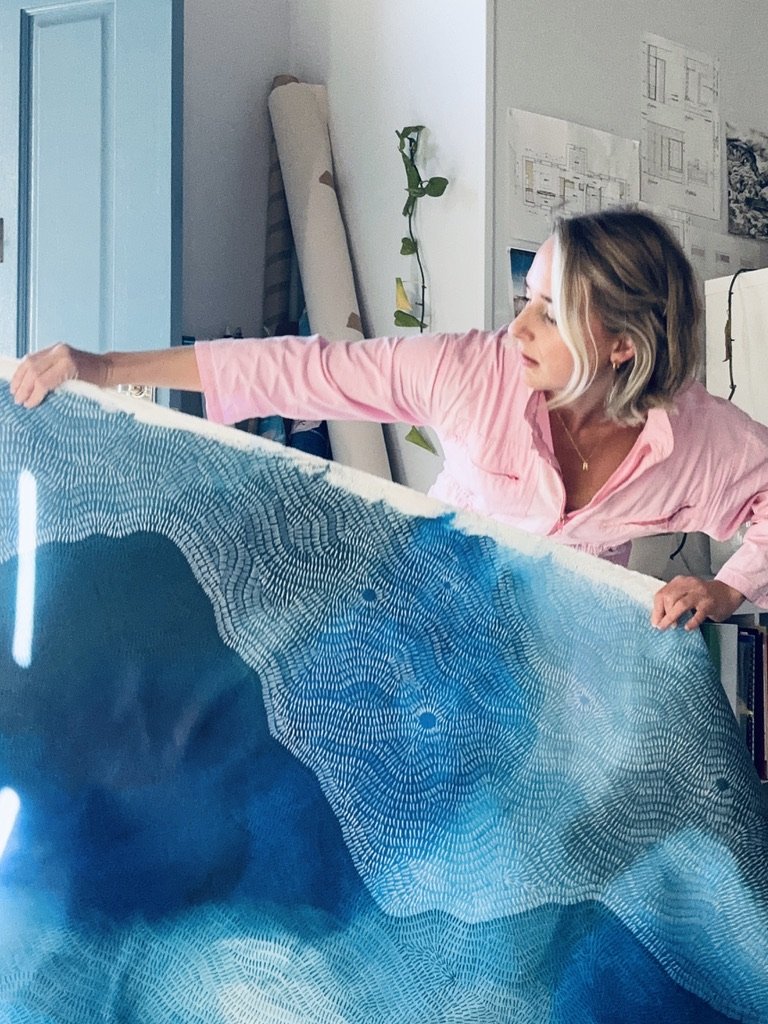
Zoë Fitzherbert with her work Moonlight Tarn IV
Where did you grow up, and how did you come to call Lutruwita/Tasmania home?
My childhood was spent gazing through the mist at receding hills in the southern highlands of New South Wales. That, and the idyllic blues, greens and browns of that region, have continued to be a real motif for me throughout my life and work.
From a young age, I attended a boarding school 1.5 hours away in Sydney, so my social network ended up being largely based in the city. But I do still feel an emotional pull to the highlands, and - although I don’t have any family there anymore - I make sure to stop into the area whenever I’m nearby.
Hobart came on to my radar in early 2017 when I visited for a hike with a dear friend. I still remember getting on to the Tasman Bridge in the hire car and seeing Kunanyi for the first time - I thought, I have to move here. I’ve got goosebumps just thinking about it.
Back in Sydney, I was working in a great job as an architect, had a great group of friends, and a great sharehouse in Paddington. There was no real reason to uproot everything just because I liked a mountain I’d seen in Tasmania. But, after I had my first son, my life went through a very difficult phase, and I had this sudden lightbulb moment - I’m going to move to Hobart. It was a huge leap of faith and I was very lonely at first, but things gradually began to improve. I’ve now called Tasmania home for more than five years.
You’re now working as a landscape painter. What inspired you to transition out of the world of architecture, and into a quite different creative pursuit?
When I look back and try to retro-analyse what’s happened in my life, art has always been there, even informing every choice I’ve made professionally. I had just never allowed it be the only thing until more recently. I chose architecture because I felt that it was a good use of my brain, while also harnessing this huge creative drive that I have. My great-grandfather was a renowned architect, so there was an understanding in my family that I was his ‘throwback’. He was an artist, too, but - like me, once - he never let that be his main thing.
Art has always been healing for me. Every moment that I had to stop and breathe, I would turn to painting, and it gradually began to take over. I never had the expectation that it would become my be all and end all, but slowly and surely, it has inched into being a very real and suddenly sustainable livelihood.
Much of your work shares a recognisable trademark style. What informs these very Zoë Fitzherbert elements?
I’ve always been drawn to seascapes, mountains and maps, and those three elements have always been in my work. I like to chase the sense that the further away something is, the more magical it becomes. There’s a beautiful melancholy and nostalgia in distance, whether it’s temporal like a memory of something, or geographical like the receding hills.
The way in which I’ve tied all of these things together in my work has come about only recently, with the catalyst being that I found the maps that my great-grandfather had drawn. A family member gave me one that was fading, and asked me to revitalise it with archival ink. I literally got to trace the work of this man whose example has informed so many of the choices that I’ve made in my life, as an architect and an artist. In doing so, I got to feel the way that he used tiny lines to inscribe mountain ranges from above. That motif of repetitive lines is now the motif that runs through all of my paintings, and the key distinction that sets my work apart from that of other painters.
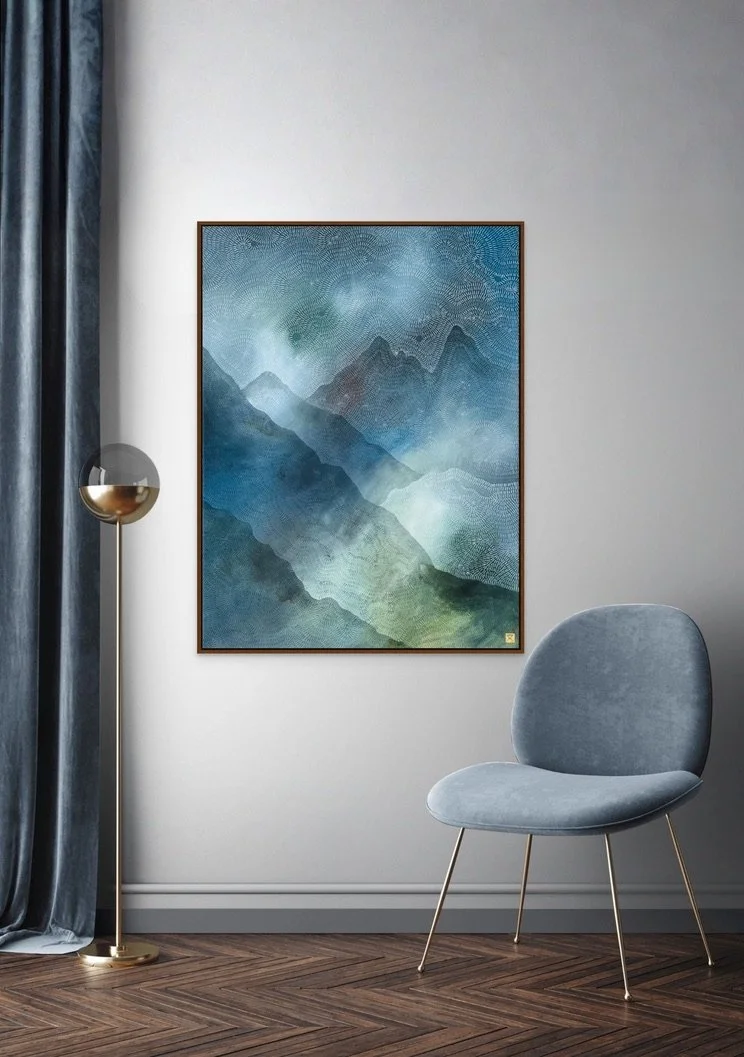
Zoë’s recently completed commission of Cradle Mountain
How important is the Tasmanian landscape to your work?
It’s 100% critical at this point. I feel that it’s impossible for me not to be an artist in Tasmania - the two things are tied together. Tasmania feeds me.
You won last year’s Henry Jones Art Painting Prize with your work Oberon’s Throne. What did it mean to you to be recognised in that way?
I can’t take it for granted, and it still doesn’t feel real. When it was announced, I wept. To have left a very secure, highly regarded profession as an architect and thrown myself into painting, and then to have an incredible organisation with incredible judges recognise this curveball that I threw myself as valid and worthy - that’s everything.
Having my work recognised in this way is like getting a foothold in the professional mountainside, because there’s a lot of climbing up and slithering back down. As an artist, you don’t only need to have creative drive; you also need huge ambition, because there are so many other wonderful artists out there. It takes a lot of courage and persistence. To have heard this big ‘yes’ helped to offset the many times I’ve heard ‘no’.
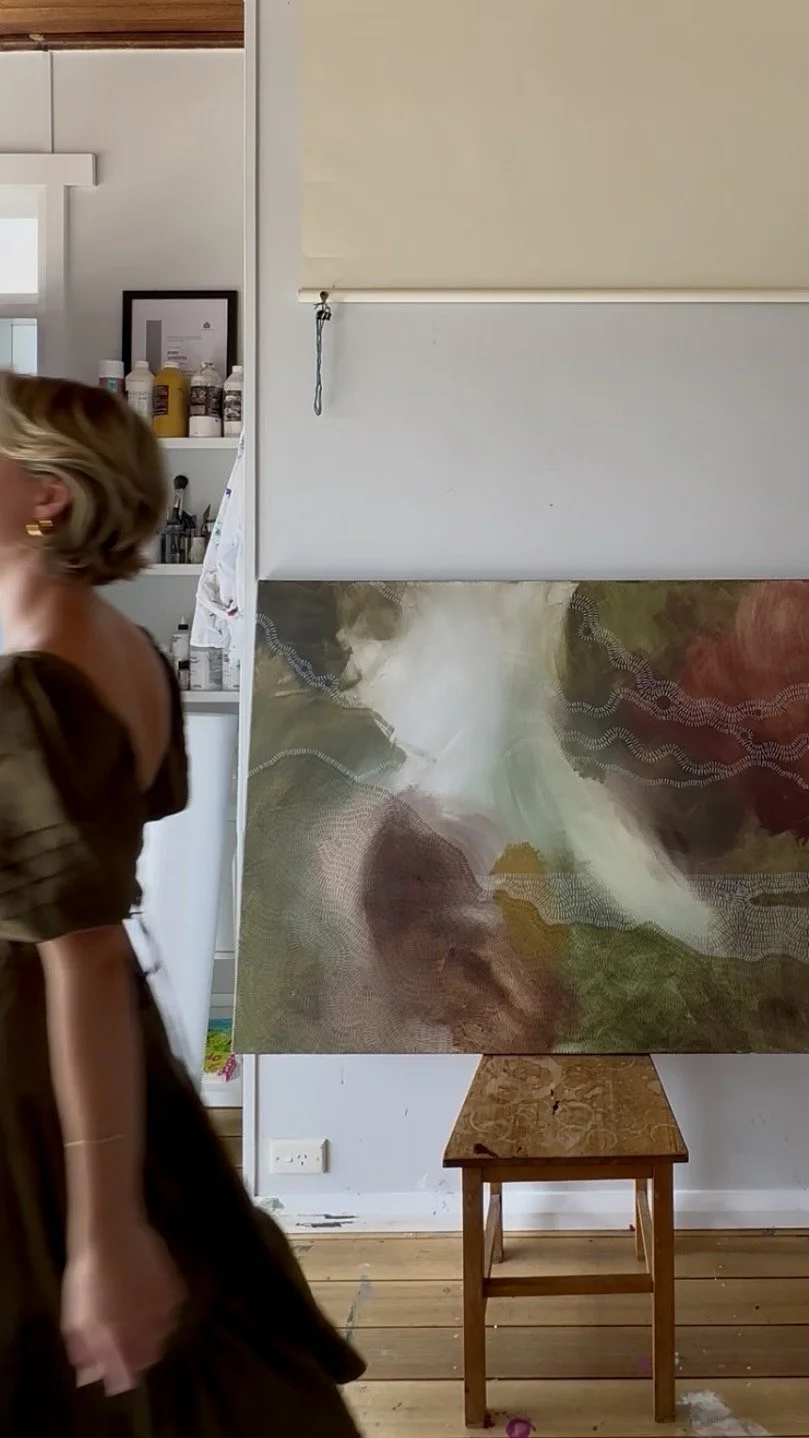
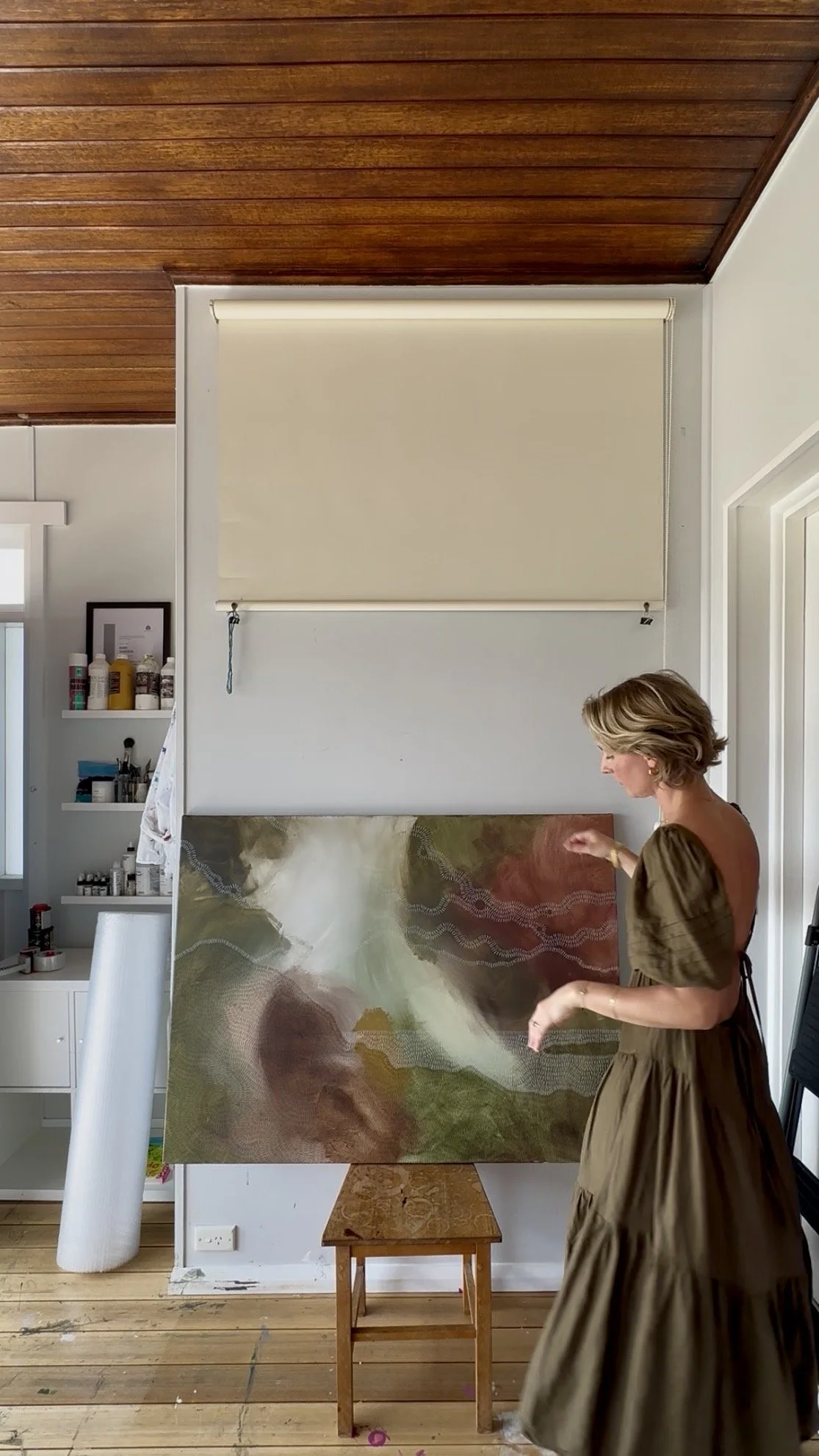
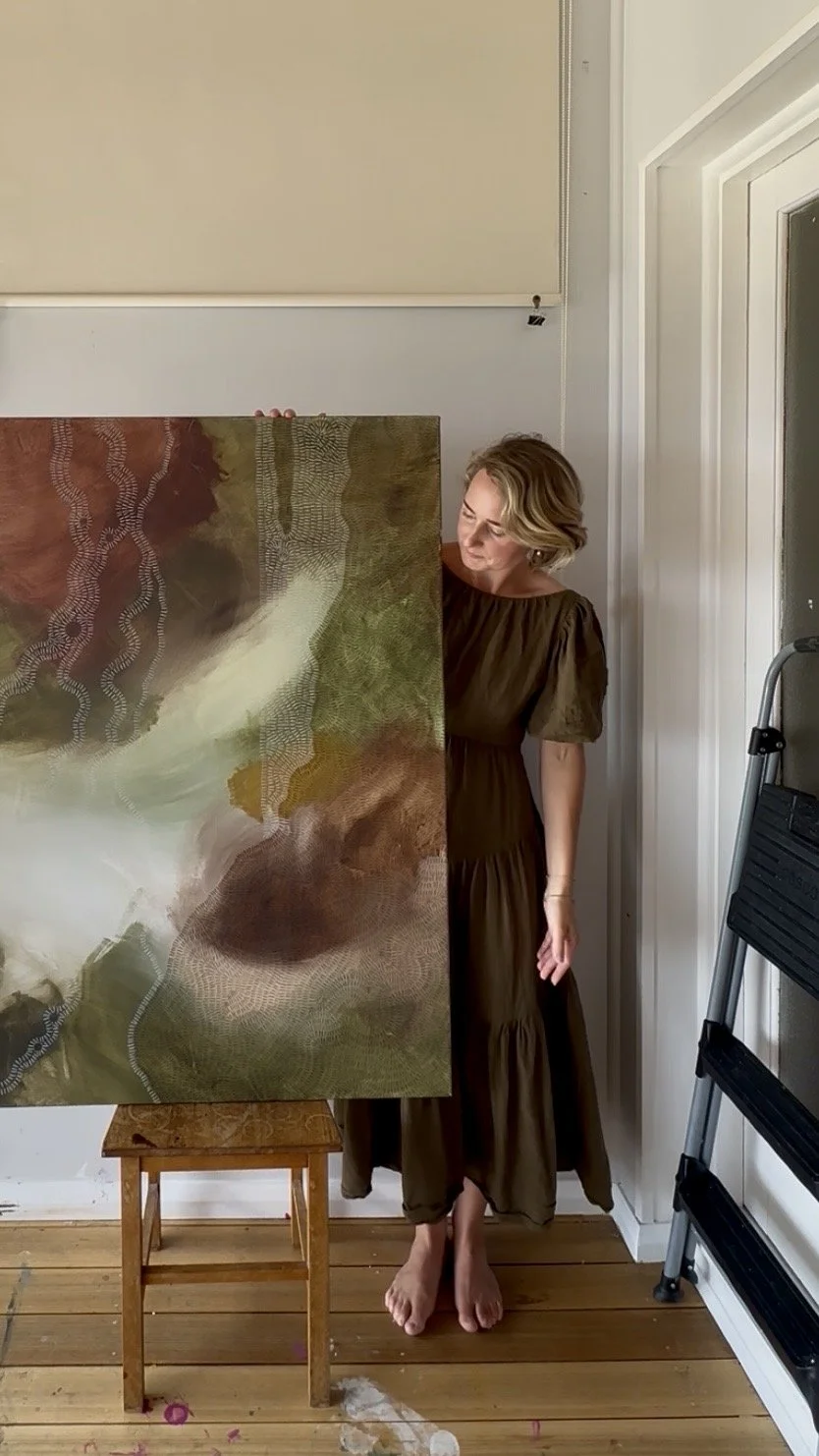
Zoë with an unfinished piece for her debut mini solo exhibition at Michael Reid Southern Highlands in May 2026
What does a typical day in your life look like?
I start every day with a boiled egg, and two slices of toast - one with Vegemite, and one with Grumpy Bee creamed honey from the market. I’ll generally do some life admin from home - checking in with orders, prints that need to be signed and posted, and whatever else needs to be done. I love this part of the day. I love the challenge, the goal-setting, the ticking off the list - it’s a really nice counterpart to the fluidity and flow and freedom that I need in my practice as an artist.
Then I’ll head into the studio, which I’m very lucky to have at home. I might work on the background layers of a couple of pieces at the same time, and while they’re drying, I can start building up the detailed layers of other pieces. They’re very different processes - the background layers are very fluid and impressionistic, while the details are much more meditative and rhythmic. It’s fun to go back and forth between the two.
I take many break stops for a cup of Elmstock Ceylon Pekoe, which I buy in bulk and drink with a generous splash of full-cream cow’s milk.
I generally get to about the five-hour mark of painting and that’s me exhausted. I’ve never done an eight-hour day in the studio, but I need to remind myself that I supplement all of the creative work with business, which happens at the beginning, middle and end of the day, so the whole thing becomes more than a full-time job. The entrepreneurial lifestyle of being constantly on-call requires a good balance of boundaries that I don’t yet have!
Evenings look like dinner, bath and bed routines with my two boys, including millions of questions from the eight-year-old. After that, it’s a full collapse, generally with a good book. I love a murder mystery - stuff that feeds the soul without being too challenging.
Where are your favourite local haunts for eats and drinks?
I don’t get out anywhere near enough, but we love Ogee whenever we can get in for a date night - something that I’ve made a resolution to do more of this year.
We recently went to Restaurant MARIA which was beautiful. The wallaby tartare was amazing, and my partner’s vegetarian option was outstanding, too.
We also need to take a moment for The Black Footed Pig’s pink eye potatoes. They’re crispy and salty - that and a cocktail is all you need.
What are three must-dos for every visitor to Lutruwita/Tasmania?
I send everyone for a day trip to Richmond. It’s touristy, but for good reason.
You can’t go past Cradle Mountain for iconic Tassie glory.
And I personally love a meander up the Midlands, stopping at each of the towns on the way. There’s some wonderful antique-ing to be done, and I love losing myself in the history of the sandstone cottages and churches.
Where do you get away to for a Tassie staycation?
We love anywhere around Bicheno on the east coast, or Port Arthur on the Tasman peninsula. We recently had a stunning stay at Frankie Beach House in the sand dunes at Bicheno. It has the most beautifully robust interior design and decor, and little details to discover. It was a nice little splash-out moment.