Q&A: Caroline Thomas
From leading challenges up mountains and across south-west Tassie’s waters to raise funds for people living with type 1 diabetes, to navigating life after a traumatic brain injury - this Ulverstone-born adventurer has found new purpose in simple rituals, the great outdoors … and making milkshakes for local blood donors.
▼
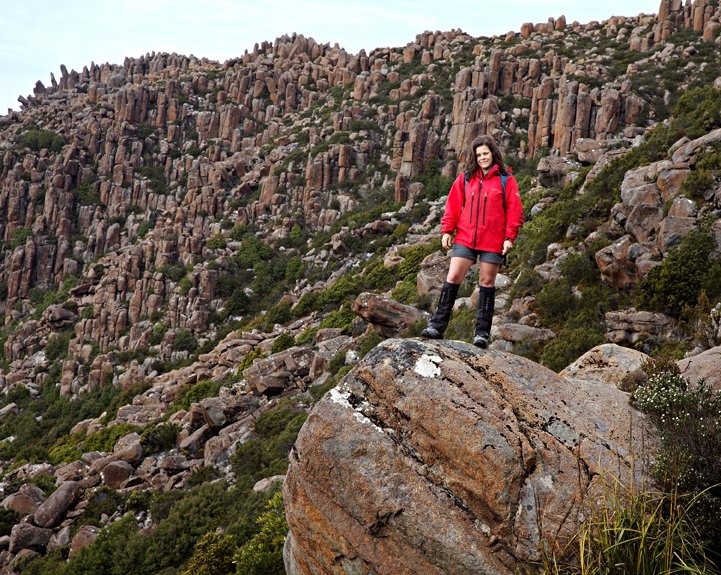
Caroline Thomas on Kunanyi/Mt Wellington (image: Richard Bennett)
Where did you grow up, and how did you come to call Nipaluna/Hobart home?
I grew up in Ulverstone on the north west coast of Tasmania, and moved to Hobart when I was 17 years old to study hospitality management at Drysdale. After graduating, I did the usual backpacking pilgrimage to the UK, before returning to Hobart in my early 20s, where I managed the Polar Parlour, a busy ice cream bar that is now Mures.
After a brief stint running a resort on Phillip Island, I returned to Hobart, and worked for Medicare and then Ochre Health while raising my two sons, Caleb and Toby.
Somewhere along the way, you started climbing some of the world’s tallest mountains. What inspired you to do that?
I went through a bit of a rough patch in 2007, and felt that I needed a personal and physical challenge to shake things up a bit, so I decided to climb Mount Kilimanjaro. I live with type 1 diabetes, and I realised quite quickly that I had completely underestimated the challenge of climbing the highest free-standing mountain in the world. I got pretty crook training for the climb, and ended up in hospital, but I just went ahead and did it anyway.
It was such a challenging thing to do, and it changed my life. When I got back, I decided that I wanted to share what I’d got out of it with kids who live with type 1 diabetes. I organised a challenge in Tassie, recruited five kids, trained them for four months, and then took them out on the Overland Track.
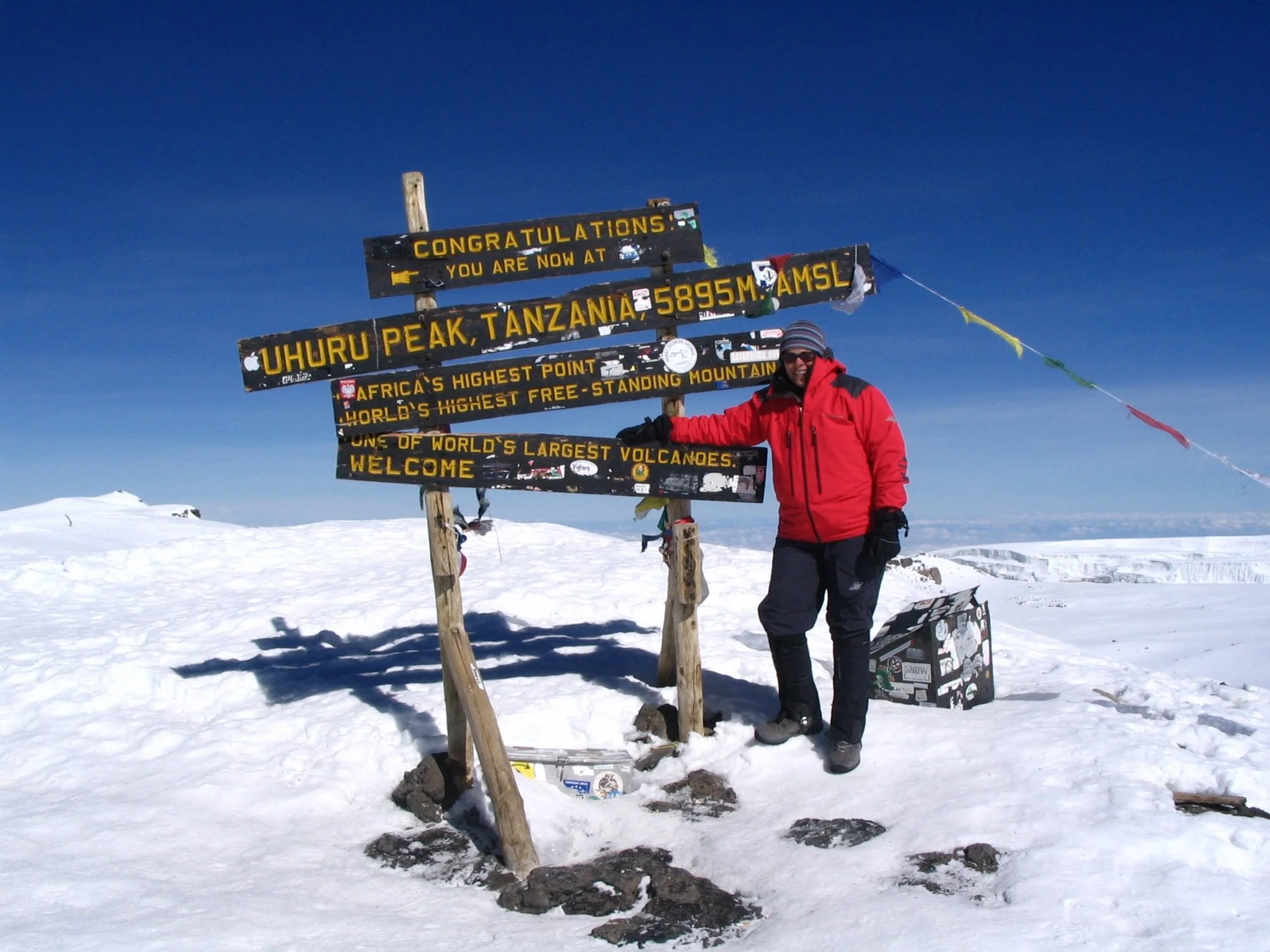
At the peak of Mount Kilimanjaro (image supplied)
Since then, you’ve taken on several other pretty epic physical challenges. What have been some of the highlights?
In 2008, (Tasmanian Deputy Premier) Guy Barnett, who also has type 1 diabetes, and I organised a fundraiser for JDRF (now Breakthrough T1D) and Diabetes Australia that saw a group of us take on the Kokoda Trail. That was even trickier than Mount Kilimanjaro - Kili was all uphill for five days, whereas Kokoda was up and down, so I hypo-ed every night. But you eat and you rest, and you manage.
I met the CEO of Diabetes Australia on that trip, and was able to get sponsored to then take a group of eight kids from around the country up Mount Kosciuszko on World Diabetes Day - that was special.
After dislocating my hip and femur near the finish line of a half marathon in Paris in 2009, I took up cycling. That’s when I started organising fundraising challenges for Life for a Child, a charity that helps to provide insulin and supplies to children in developing countries - these kids would die without them. I’d take groups on multi-day cycling trips in countries like Sri Lanka where Life for a Child was running its clinics, and we’d raise funds to help them do their work.
I also did some paddle fundraisers, including one in Fiji and two down in the south-west of Tassie with Roaring 40°s Kayaking. That part of the state is so beautiful, remote and untouched. They were fabulous trips.
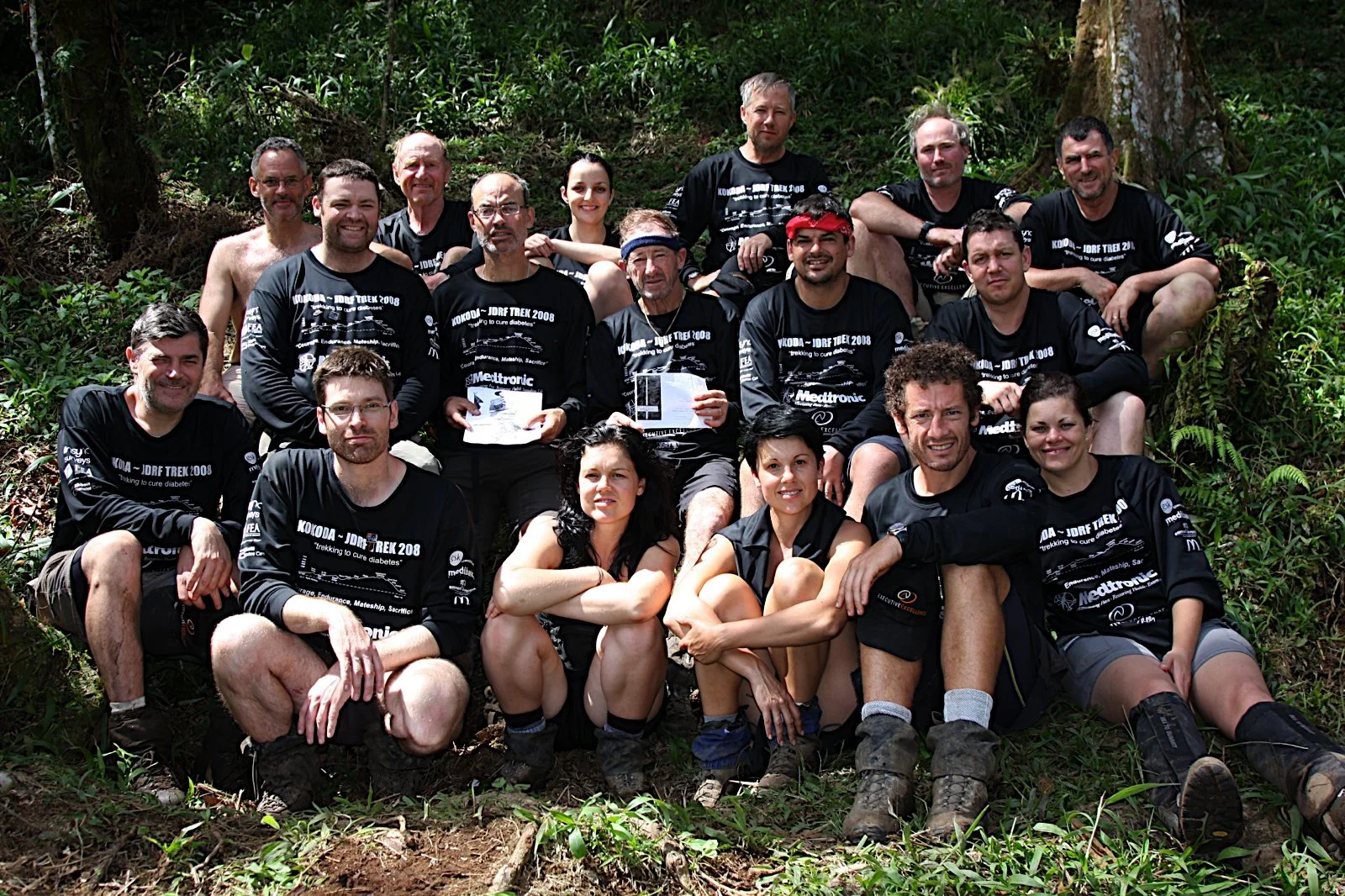
Caroline (front, far right) and the Kokoda Trail fundraiser team
By the 2010s, you were working full-time at Diabetes Tasmania, looking after a national program for older people with diabetes. What happened next?
I call it the big bang. In 2017, I’d just returned home from a 10-day trek in Peru, and I was out in our vegetable garden looking at the rhubarb. I don’t really remember what happened next, but I think I fell and hit my head on the uncapped metal end of our Hills Hoist, resulting in a concussion with post-concussion syndrome. If I’d done the same injury now, the recovery trajectory would have been very different, because there’s much better awareness about head injuries today. But, at the time, it was very difficult to get the right help.
It affected pretty much everything - my cognition, speaking, sensitivity to noise, energy … I had this incredible pressure in my head and explosive headaches. The major lingering impact was problems with my vestibular ocular reflex, which is basically how your brain talks to your eyes. If it’s not working properly, it makes you tired, gives you headaches, and makes it hard to concentrate. For me, those problems are ongoing, and I never went back to work.
About two and a half years after the injury, I started seeing a Hobart neurological physiotherapist Phil Ladlow. He’s the recipient of a Churchill Fellowship, and spent time travelling around the world studying traumatic brain injuries, and new ways of treating them. Seeing Phil has been a huge help, and we’re currently working with virtual reality goggles to treat my symptoms, and seeing some good improvements.
What does your day-to-day look like since the injury?
About four years after the big bang event, I decided that I was ready to take on a bit more. I thought about learning to drive again, or finding a volunteer position. My partner Craig is a fortnightly plasma donor at Lifeblood, and suggested that I could be a “milkshake lady”, welcoming donors and making them a drink and snack in the refreshment area after their donation.
It was really hard at the start - I only did an hour at a time, and it would wipe me out with debilitating fatigue for the next couple of days. But I’ve progressively built up to three hours a week, and have been there for three years now. I love it. I feel like I’m giving something back, it gives me purpose and a sense of normality.
My life outside of being a milkshake lady is a good one. Craig and I live in lower Sandy Bay, so I walk along the beach to Battery Point or Sandy Bay every day, and spend a lot of time with my family throughout the week. I’ve also taken up yoga and mindfulness practices as a way to manage the symptoms of the brain injury. It doesn’t take the pain away, but it does change your relationship with it.
It’s a quiet, slow life, and living in Tassie is perfect for that.
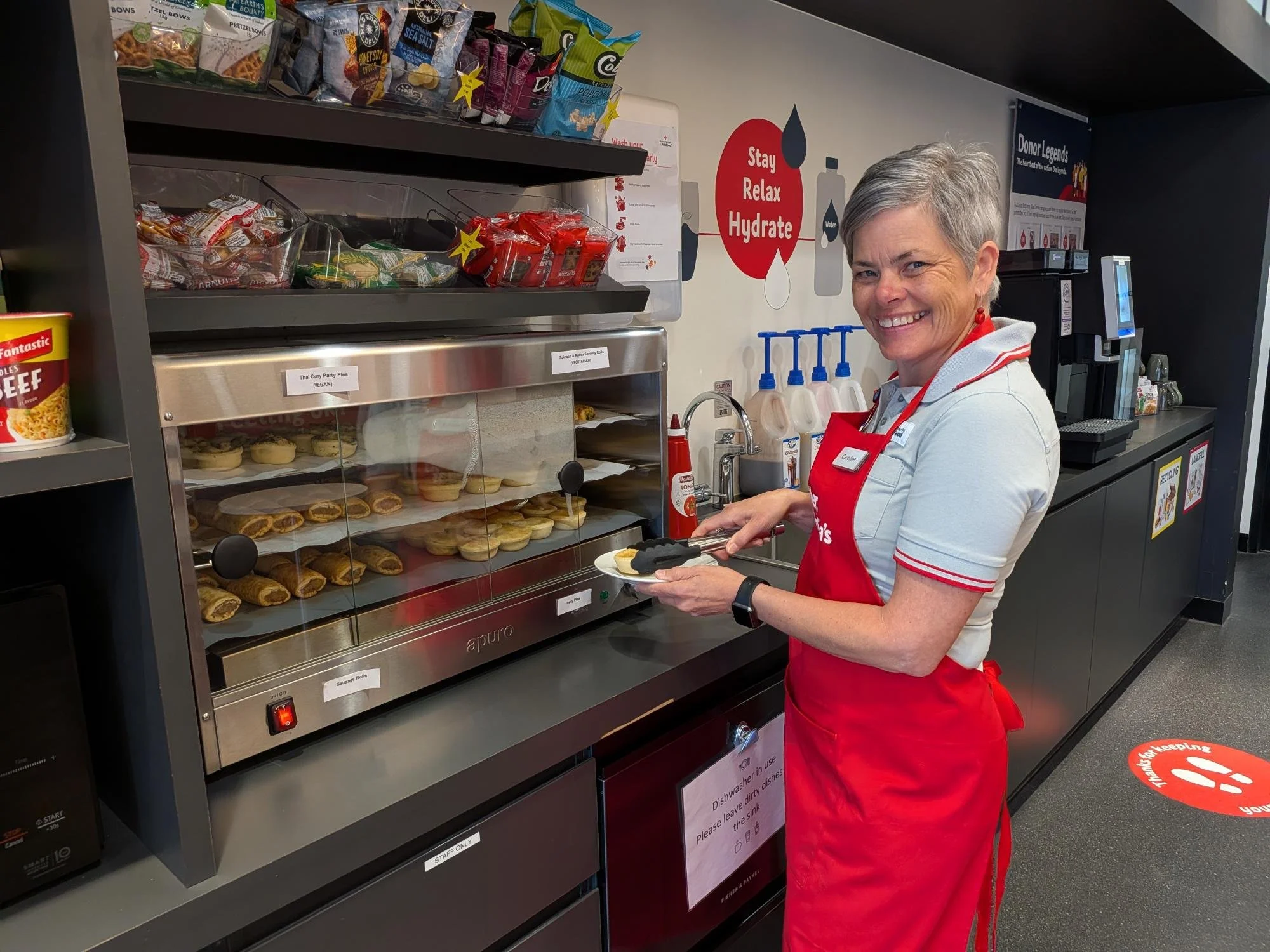
Volunteering at Lifeblood’s Hobart donor centre (image supplied)
Where do you get away to for a Tasmanian staycation?
I love Falmouth on the east coast. It’s just a grid of shacks out on a little peninsula betwen Scamander and Bicheno. There’s no shops, but there are plenty of beautiful cliff walks. Closer to where I grew up, I love Three Sisters Retreat in Penguin, a little cottage up on a cliff overlooking Bass Strait.
What does the perfect day in Tassie look like for you?
I’d start with a coffee in bed with Craig looking out to our view of the mountain and water, then head up to Lost Freight on Kunanyi for a coffee and a cookie, and a short walk. Bushwalking is one of the things I miss the most since experiencing the complications of my brain injury, and I’m working towards being able to drive myself up the mountain and go for a long walk. I’ve also worked hard to be able to get back to one of my other favourite treats, which is visiting Fullers and reading a book over a cuppa, so that would be my afternoon. And I’d finish the day by seeing a movie with Craig or a friend at the State Cinema in North Hobart. I love that you can take in your glass of wine and a Valhalla choc top!
What are three must-dos for every visitor to southern Tasmania?
If you’re able to donate blood or plasma, come to the Hobart Lifeblood Donor Centre, do your bit, and then enjoy a cuppa or a milkshake! I always recommend a walk on Kunanyi - the Octopus Tree is an easy one-kilometre walk, and there’s plenty of longer hikes like the Organ Pipes and The Springs, all the way through to the Lost World walk, which is more advanced and a real experience. And, finally, take a drive down to Peppermint Bay for a wine and something to eat overlooking the water.